





 skool@b4fitness.org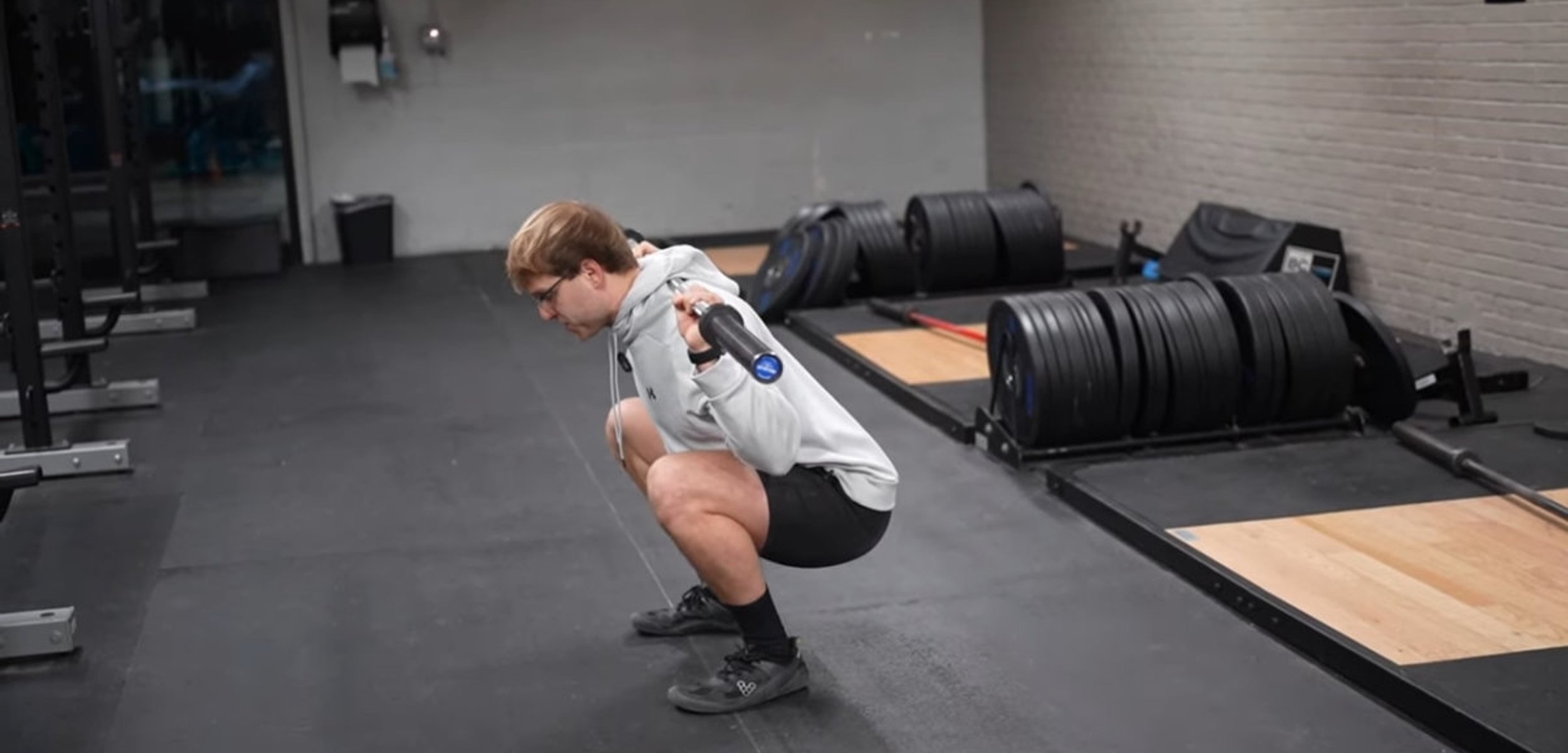
If your heels rise off the floor when you squat, you've probably been told to "sit back more," slap a plate under your heels, or just stretch your calves. Maybe you've tried all three. Maybe the problem is still there.
Heel rise in the squat is one of the most common movement issues in the gym, and one of the most misdiagnosed. It looks like a simple fix on the surface, but it's usually pointing to something deeper going on in one or both of two places: your ankles and your hips.
Understanding which one is driving the problem, or whether it's both, is what separates a real fix from a workaround.
What's Actually Happening When Your Heels Come Up
The squat requires two things to happen simultaneously: your hips need to fold deep into flexion while your shins travel forward over your feet. That forward shin travel is called ankle dorsiflexion, and it's non-negotiable in a full squat. At the same time, your hips need enough mobility to allow deep flexion without the pelvis dumping into a posterior tilt (the "butt wink") or the torso collapsing forward to compensate.
When either system runs out of range before you hit depth, the body finds another way to get there. The most common solution? The heels come up. Suddenly you have more apparent depth, more forward lean, and a lot more stress on your knees and lower back than the squat was ever supposed to create.
The Two Root Causes
1. Ankle Mobility: The Most Common Culprit
Restricted ankle dorsiflexion is the single most frequent cause of heel rise in the squat, and it's almost always present to some degree in people who spend significant time in shoes, sitting, or doing repetitive athletic activity without addressing it.
Dorsiflexion is the movement that brings your shin forward over your foot, the range that allows your knee to travel past your toes as you descend. The ankle needs roughly 15-20 degrees of dorsiflexion for a clean squat pattern. Most people have far less than that on one or both sides.
The restriction can come from a few places: tightness in the calf complex (gastrocnemius and soleus), stiffness in the joint capsule itself, or limited mobility in the subtalar and midfoot joints below the ankle. Stretching the calf addresses one layer of this. But if the restriction lives in the joint capsule or foot, calf stretching alone won't get you very far; which is why a lot of people stretch their calves religiously and still squat on their toes.
The heel-elevated workaround (squatting with plates or wedges under your heels) addresses the symptom by reducing the dorsiflexion demand. It's not inherently wrong, and it has legitimate uses. But if you rely on it indefinitely without working on actual ankle mobility, you're training around a limitation that will keep expressing itself elsewhere, in your running, your jumping, your lunges, and eventually your knees.
2. Hip Mobility: The Less Obvious Factor
When the hips can't achieve full flexion, the pelvis compensates. It posteriorly tilts (tucks under), the lumbar spine rounds, and the torso pitches forward. To prevent that forward fall, the body instinctively unloads the heels and shifts weight forward, heels rise as a balance response to hip restriction.
Hip flexion range varies enormously between individuals, partly due to mobility and partly due to anatomy (the shape of your hip socket and femoral head play a role). But for most people with limited squat depth, hip mobility is a trainable factor, not a fixed structural ceiling.
Hip internal rotation is particularly important and frequently overlooked. As you descend into a squat, the femur rotates internally relative to the pelvis. If that internal rotation is restricted, the squat mechanics break down early in the descent and the body compensates with heel rise, knee cave, or excessive forward lean, often all three together.
Cues and Fixes That Actually Help
Test ankle mobility first. Kneeling facing a wall with toes 2-3 inches away; try to touch your knee to the wall without your heel leaving the floor. If you can't get there, or there's a significant difference between sides, ankle mobility is a factor that needs direct work, not just better squatting technique.
Work the ankle joint, not just the calf. Ankle dorsiflexion work should include banded joint mobilizations (distraction of the talus) alongside calf and soleus stretching. The joint capsule responds to different inputs than the muscle belly. Both need attention if you want lasting change.
Open up hip flexion with active range work. Passive stretches (pigeon pose, figure-four) have their place, but the hip needs active control at end range, not just the ability to be pushed there passively. Controlled hip flexion work, slow, deliberate movement into the deepest range you can actively own, builds the kind of mobility that holds up under the load of a squat.
Develop hip internal rotation. This is the missing piece for a lot of people. Dedicated hip internal rotation exercises done with control will often unlock squat depth faster than any amount of hip flexor stretching. If your knees cave inward as you descend, restricted internal rotation is likely a major contributor.
Use the cue "spread the floor." Instead of thinking about sitting back or pushing knees out, focus on screwing your feet into the ground, as if you're trying to spread the floor apart beneath you. This cue activates external rotation torque at the hip, creates a more stable base, and often naturally improves knee tracking and depth simultaneously.
Own the bottom position. Spend time in the bottom of the squat without weight, or with minimal load, working your way deeper with each breath. Assisted deep squat holds, where you hold a post or rack for balance while you relax into depth, train the nervous system that this position is safe. Over time, your active range expands to meet it.
Don't chase depth before you earn it. Squatting deeper than your current mobility allows, by compensating with heel rise, butt wink, or forward collapse, doesn't build your squat. It builds compensations. Earn each increment of depth with actual mobility improvement and it will transfer to loaded squatting. Borrow it through compensation and the problem follows you up in weight.
The Short Version
Heels rising in the squat means the body ran out of range somewhere before it hit depth. Nine times out of ten, that's the ankles, the hips, or both. No cue fixes a mobility deficit; but the right mobility work, done consistently, changes what the squat looks like without you having to think about it.
That's the difference between correcting a movement and building the capacity to own it.
At B4 Fitness, we address both because a squat where the body has the range to do it right is a squat that keeps building you instead of breaking you down.